Saturday, May 14, 2022

21 #blessed

Ah, this is a favorite topic of Kate Bowler's - something she has written about before. Railed against, you might even say. (I think she would, at least!) 

We tend to add the #blessed hashtag to the good things in our lives: the perfect pictures on social media or when we (not so) casually mention our promotion at work.  

Since we're 21 entries in, I'm guessing that you've noticed the entries all include a blessing of one sort or another. And often, those are the parts of the chapter I love the most. In the video promo for this "Good Enough" book, I think she even mentions something about believing in blessing the crap out of everyone. 

And she really means that with all her heart ... but not in the "partially nude bikini shot" or "Christmas card professional photo shoot where everyone is looking directly at the camera wearing matching chambray tops" kind of way (p 122). 

When she says #blessed, she means it the way Jesus uses that word: 

  • Blessed are you when you are at the end of your rope. 
  • When you are exhausted and despairing. 
  • When tears are your food, morning and night. 
  • When your stomach grumbles and your mouth is dry. 
  • Bless are you who forgives the person who never said sorry and who definitely didn't deserve your forgiveness. 
  • You who are ridiculed and humiliated, left out and left behind. The timid and the soft-spoken. The one who works toward peace instead of the easy road of vengeance. (p 122) 
(You can read Jesus' exact words here in Matthew 5.) 

Kate and Jessica write, "These beatitudes should make us uncomfortable. Because God is celebrating who we try so hard not to be. Dependent. Needy. Desperate" (p 123). 

These words are not for the folks who are "succeeding" at life. That's not who Jesus was talking to. 

"He was looking into the eyes of those who felt like the misfits. And then used everyday experiences of weeping, hungering, thirsting, suffering as a badge of belonging" (p 124). 

In an interesting moment of serendipity, I am 98% of the way through a novel (audiobook, for the record) that is told from the perspective of someone who feels very out of place among her friends, as she looks at their perfect lives that seem to have turned out the exact way they expected whilst wondering where she has gone wrong because NOTHING in her life had turned out the way she expected. 

Spoiler alert: it turns out no one's life turns out the way they expected. And while they may not say it out loud, no one really thinks they have it all together. 

Spoiler alert for the book, I mean, ... but maybe also for real life too. 

The longer I listen to the book, the more I want to slide into Kate Bowler's DMs to recommend it to her! I think she would love it - it's a beautiful if profanity-laden meditation (and I'm using that word loosely!) on the reality of life and when you feel like a misfit and how beautiful and raw and honest conversations can connect you to another human being unlike almost anything else. I have chuckled out loud numerous times as I've listened while doing my dishes but also (carefully) wiped my eyes as they filled up with tears. 

The left out will be welcomed with a warm embrace. The forgotten will not just be remembered but honored. The ones who don't have it all together are exactly who God is inviting into the kingdom. In fact, the whole kingdom belongs to the ones on the edges. This is the upside-down kingdom - directly available to those of us who don't have it all together (p 124).  

Blessed are we. The imperfect and don't-have-it-all-together. God's beloved.

Pastor Allison 


I'm curious: 
Maybe go back and re-read "A Blessing for When You Don't Feel #blessed" again (pp 125-126). Are these words you need to hear? Are they words someone else needs to hear? I think twice now I've sent pieces of the blessings from this book to those who are struggling. Maybe share a paragraph or two from this one with someone. Or, maybe get them their own copy of this book! 

I love this snippet from the Madeleine L'Engle quote on p. 127: "I have suggested that it is a good practice to believe in size impossible things every morning before breakfast, like the White Queen in Through the Looking Glass. It is also salutary to bless six people I don't like much every morning before breakfast." 

Jessica and Kate write: "Your turn. Think of six people you don't like very much. I certainly didn't have to look too far. Bless them. Even ... especially ... if you don't want to" (p 127). 

Friday, May 13, 2022

20 Becoming Real

Will you stop reading this blog if I tell you I'm not sure I've ever read The Velveteen Rabbit? 

Or, if I have, it's been so long ago, I don't remember it. Nor do I have a particularly nostalgic feeling about it like so many other people do. 

With all that being said, I can still appreciate the beauty of the story - the beauty of being made real through our wear and tear. 

And the beauty of these words: 

As the Skin Horse explains, “Generally, by the time you are Real, most of your hair has been loved off, and your eyes drop out and you get loose in the joints and very shabby. But these things don’t matter at all, because once you are Real you can’t be ugly, except to people who don’t understand.”  (pp. 118-119)

What may be even more beautiful is the story behind the story - that the author, Margery Williams came to love literature through her father who died suddenly when she was seven. Kate and Jessica write, "In her stories for children, there is a tender ache for the lives we’ve lost and the loves that endure. We are changed, and we often wish it were otherwise" (p 118). 

We've already talked about "Mourning A Future Self" and the difficulty of knowing that even as we have to say goodbye to something we will deeply mourn, there is still a chance to say hello to something new which is born in its place ("Hello, Goodbye"). Kate and Jessica are no strangers to looking deeply into loss and pain in a very real and genuine way. 

As they have in so many of these entries, Kate and Jessica don't try to erase or resolve the tension inherent in being human. Indeed, as Kate writes in another book, there is no cure for being human; no way to escape death and suffering without also squeezing out any sign of life. 

There will always be "a tender ache for the lives we've lost and the loves that endure. We are changed, and we often wish it were otherwise." 

Perhaps we, like the Velveteen rabbit are getting a little shabby from the wear and tear of loving and living which may not sit well in an Instagram world. But we are not coming undone; rather, we are becoming - becoming more real than we ever have been before through that tender ache. 

Blessed are we who are becoming, who have lived so long in this strange state we call time that it shows. We are changing, and that's how we know we are alive. 
...
You may not recognize yourself in the mirror. But this is what we hoped for, right? To live and love. To be loved. To have our experiences show on our faces and in our cells. It is the real life of Jesus in us, being made visible, as all our seams show" (p 12). 

Pastor Allison 


I'm curious: 
What does the story of "The Velveteen Rabbit" mean to you? Was it a favorite growing up? If so, who read it to you? 

From the "A Good Enough Step" on p 121: 

Find a minute alone. Take out a photo of yourself as a child. Allow yourself to appreciate what was - who you were. All the pain you had yet to know or perhaps already did know. ... But then also take time to tell your younger self all the way that living and aging and suffering have carved out within you a space for reality and more love and compassion for others. Be effusive! If a prayer comes, pray it. If a poem appears, write it. If you want to create art, do it. 

Thursday, May 12, 2022

19 No Reason Whatsoever

I love learning new words. And it only took 2 paragraphs from today's Good Enough entry to teach me a new word. 

Hyper-instrumentalization. The obsession with use. 

"It's a symptom of the pragmatism that has wound its way into almost every part of American culture. How useful was your day?" (p 110) 

This raised an interesting question for me: do I ever do anything I'm not good at or for no good reason? 

I've already told you that I'm an over-achiever by nature and nurture here, so of course, I don't! And I have inherited the competition gene from both of my parents (though each would say the other is more competitive!). 

I suppose that without even realizing it, I have fallen into the habit of hyper-instrumentalization -- thinking that everything I did needed to be done well and have some purpose to it. 

But I do have a playfulness streak in me - a streak that I think has gotten stymied in the last couple of years for any number of reasons. 

In fact, not long ago, I was reading a book with some friends, and one of the chapters was about the spiritual discipline of playfulness. And I puzzled over what silly, playful thing I could do on my own. 

And then I remembered that I have some friends who adopt street cats. I had previously drawn portraits of their cats with their names in fancy cat-themed scrawl. And my friends framed those portraits and hung them above their food bowls, six inches off the floor, in the corner of their dining room!!!  

Well, it occurred to me that they had adopted a new cat, and I was behind in my commissioned portraits! (I use that term very loosely!) 

So that very night, I pulled out my sketchpad, pencils, and markers, and scrolled through my phone to find pictures of the cat, and got to work, sketching away. 

It was so silly and delightful that I decided that (of course!) I should ALSO sketch portraits of my friends, so they can hang those up too! 

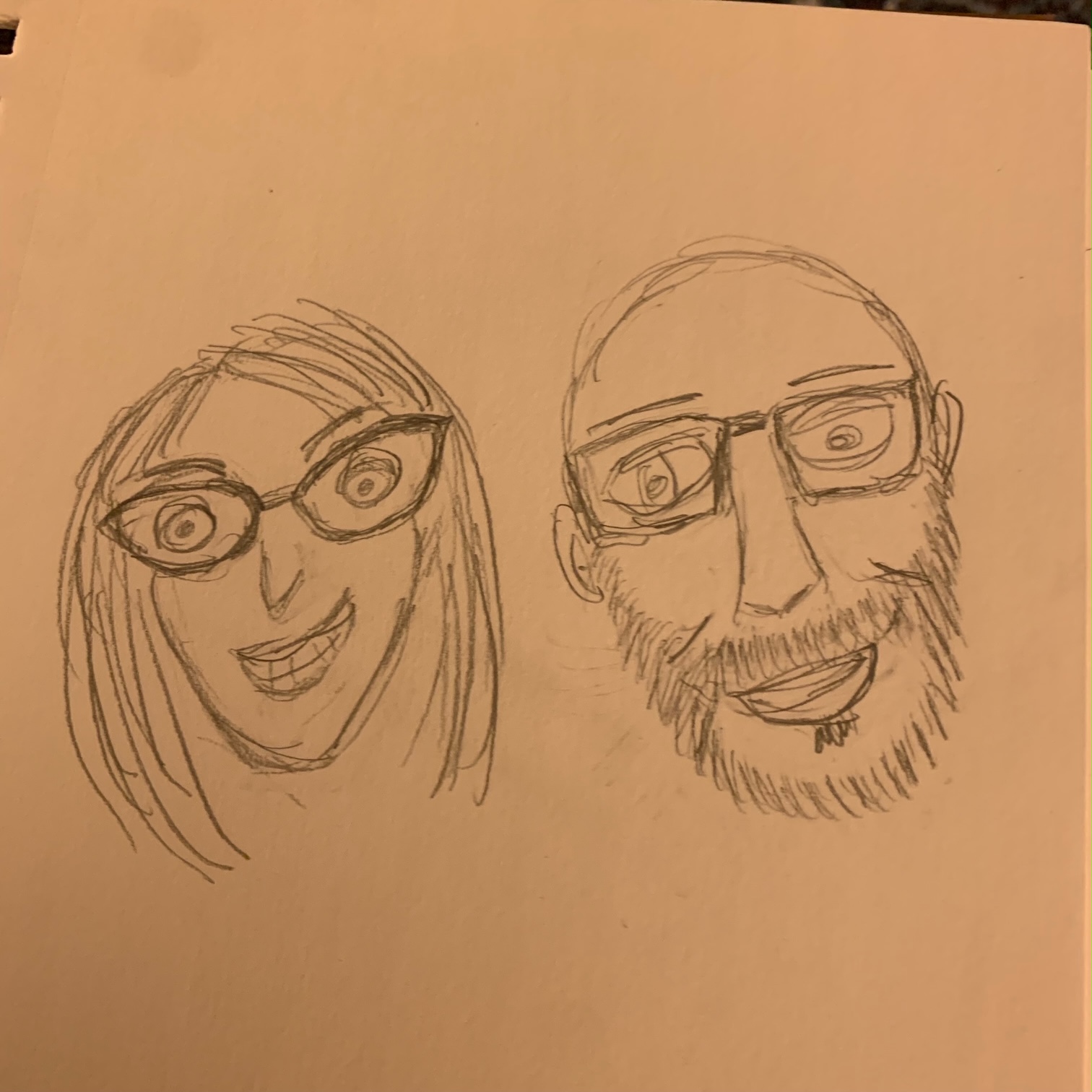
And since I know you're dying to see the pictures, here you go: 


Cat portraits to hang over their food bowls. Does it get any more absurd, really? 

Probably not. 

But what joy I experienced simply in the trying, knowing that what came out may not be high quality, but that my friends would love it anyway. 

It turns out being silly and playful comes a lot more naturally for me when other people are involved. 

In fact, after chatting about this very subject (playfulness and absurdity) with another friend who says he excels at making irresponsible and silly decisions, I may just have found my spirit guide to shedding my habit of hyper-instrumentalization. 

Blessed are you who see the art in absurdity. Because when you think about it, life is unexpectedly and terribly and wonderfully absurd. So why don't we just embrace it? (p 113) 

Pastor Allison 


I'm curious: 

What's the most absurd thing you've done lately?  If you can't think of anything, what about asking a silly friend to do something absurd with you? 

I have to say my perfect recipe for absurdity is a group of friends and one of the antique stores here in Portsmouth. There is no limit to the odd, silly, or bizarre things we can discover! 

Wednesday, May 11, 2022

18 Hello, Goodbye

Kate and Jessica say that there are two simultaneous truths (p 104): 

  1. When something changes, a world we love ends 

  2. Change happens every day. 
And so we set about trying "to solve the sorrow inherent in change by giving it up entirely. Routines become a bulwark against the threat of pain" (p 104). 

I suppose we all sank a little deeper into our routines in the last couple of years during the pandemic. We probably found even more security and safety in routines when everything else felt so uncertain and uncontrollable. Routines we can manage. Routines make us feel like we're in control. 

And while that may be appropriate for certain seasons of our lives, holding closely to our routines so as to avoid suffering ("the order of nature") will ultimately squeeze out life itself (p. 104). 

Maybe this is part of the COVID-19 hangover/sluggishness a lot of us are feeling these days. Maybe the routines that served us well before are no longer serving us in the same way. Maybe it's time to find a new routine. But we're not sure how. And that makes us afraid. 

Using what we've been learning about in this book, maybe it's time to exchange our old routines to create a routine regula we can live with hands wide open and that allows space and room for the Spirit to move in a wild and uncontainable way instead of routines that leave us clenching our fists in fear. 

But there's something else we should consider too, Kate and Jessica say. 

Not every change is a bad thing; it's just a thing that happened. What made it good or bad depends on how we responded. 

How did you respond during the pandemic? How did you respond the last time you got bad news from the doctor? When the relationship with you loved one was broken? When you lost your job? 

"Did we become better or worse? Holier or crustier? Softer or quicker on the draw?" (p 105) 

We may have had to say goodbye to a lot of things in the last couple of years; but what have we said hello to in their place? 

"May you, dear one, find comfort from places and people you don't anticipate who remind you that you are not alone. You may be saying goodbye to something - someone dear ... but something new will be born. 

I cannot promise it will replace what was there, and I won't try to tell you it will always be better. But, I do believe that we can find beauty, meaning, and truth right where we stand" (pp 106-107). 

Pastor Allison 


I'm curious: 

Are you one of those people who gets stuck in their routines as a way to avoid the pain that sometimes comes from changing? How has this entry made you re-think that way of living? Might you be ready to CHANGE something - maybe something small - just to see how you might surprise yourself with your response? 

In their "A Good Enough Step" on page 108, they suggest finding a tiny notebook and creating a list of things you're saying goodbye to - honoring each thing for its importance to you and your life. Where is the "beauty, meaning, and truth" right where you're standing, even as you're saying goodbye? 

"Truth makes love possible; love makes truth bearable."  (Rowan Williams, A Ray of Darkness) 

Tuesday, May 10, 2022

17 Hopping Off the Treadmill

I'm reading a book called, This Here Flesh by Cole Arther Riley with two of my favorite people in the world. 

We started a Lenten discipline of reading a chapter of a book together and Zooming on Thursday afternoons to discuss it, and then we decided to keep going, post-Lent. This Here Flesh is our second book. 

In the first chapter called "Dignity," Riley writes: "Our dignity may involve our doing, but it is foremost in our very being - our tears and emotions, our bodies lying in the grass, our scabs healing. I try to remember that Eve and Adam bore the image of God before they did anything at all. This is very mysterious to me, and it must be protected" (pp 11-12). 

I've been marveling over those last two sentences, especially the "very mysterious to me, and it must be protected" part. 

In our do-ing oriented world, it's hard to imagine the mystery of being beloved because we are human be-ings, not human do-ings. 

She also writes, "We cannot help but entwine our concept of dignity with how much a person can do. The sick, the elderly, the disabled, the neurodivergent, my sweet cousin on the autism spectrum—we tend to assign a lesser social value to those whose “doing” cannot be enslaved into a given output. We should look to them as sacred guides out of the bondage of productivity. Instead, we withhold social status and capital, and we neglect to acknowledge that theirs is a liberation we can learn from." (p 11) 

And then she summarizes the chapter by saying that the very idea of being valued and given dignity only for what we can do or produce, "I disagree with those who say we bear the image of God only, or even primarily, by living out our faith in our labor. The thought is reductive, and it evidences that we are content to exclude those who will never work, who may never speak, who no longer make or do. Their image-bearing is not dispensable; it is essential." (p 12)

I say all this because I can't think of a better argument to, as Kate and Jessica say, HOP OFF THE TREADMILL. 

And remember that yes, the world will keep spinning without us. 

And that we are "loved, loved, loved. Not for what we do, but for who we are" (Bowler, p 101). 

Pastor Allison 


I'm curious: 

In the "A Good Enough Step" section, Kate and Jessica write: "Take a moment to be curious. What are the non-negotiables of your day?" 

So, what ARE the non-negotiables of your day - the things you can't live without, that day isn't complete without? 

Here's a chance, they say, to hop off the treadmill ("the myth of hyper-productivity or of bottomless energy or need-to-say-yes-to-every-request-that-comes-your-way may not be serving you like you once thought" p 102) and re-define the non-negotiables and to make room for them in the jar of your life.